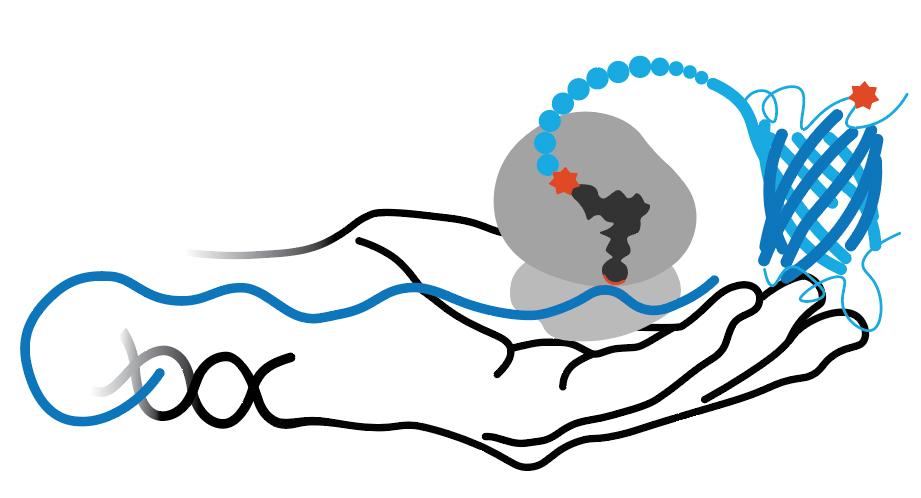
RS/tRNA Foundational Publication Support
Zhang, Meng, Shixian Lin, Xinwen Song, Jun Liu, Ye Fu, Xi Ge, Xinmiao Fu, Zengyi Chang, and Peng R Chen. (2011) 2011. “A Genetically Incorporated Crosslinker Reveals Chaperone Cooperation in Acid Resistance”. Nature Chemical Biology 7 (10): 671-7. doi:10.1038/nchembio.644.
Lin, Shixian, Zhenrun Zhang, Hao Xu, Lin Li, She Chen, Jie Li, Ziyang Hao, and Peng R Chen. (2011) 2011. “Site-Specific Incorporation of Photo-Cross-Linker and Bioorthogonal Amino Acids into Enteric Bacterial Pathogens”. Journal of the American Chemical Society 133 (50): 20581-7. doi:10.1021/ja209008w.
Yang, Yi, Haiping Song, Dan He, Shuai Zhang, Shizhong Dai, Shixian Li, Rong Meng, Chu Wang, and Peng Chen. (2017) 2016. “Genetically Encoded Protein Photocrosslinker With a Transferable Mass Spectrometry-Identifiable Label”. Nature Communications. doi:https://doi.org/10.1038/ncomms12299.
RS/tRNA Pair Development Year
2011
ncAA(s) Incorporated
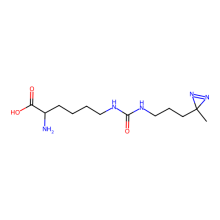
(3-(3-Methyl-3H diazirine-3-yl)-propaminocarbonyl- Nε-L-lysine ( DiZPK)
ncAA Structure (png, jpg, jpeg)
ncAA Utility
Aliphatic (flexible chain) photocrosslinker, similar in structure to the AbK ncAA.
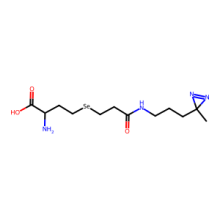
DiZHSeC
ncAA Structure (png, jpg, jpeg)
ncAA Utility
photo-affinity crosslinker with a built-in, transferable mass spectrometry label.
RS Organism of Origin
Parent RS
RS Mutations
L274A
C313S
C313S
tRNA Organism of Origin
Parent tRNA
tRNA Anticodon
CUA
Other tRNA Mutations
n/a
Multiple tRNAs?
Works equally well with Mm tRNA, and this is what is included in pCMV plasmid for mammalian expressions
RS/tRNA Availability
RS available in AddGene Plasmid #91705 (in a pSupAR vector backbone with a Cm resistance gene)
and Plasmid #91706 (for mammalian cells with a pCMV vector backbone)
and Plasmid #91706 (for mammalian cells with a pCMV vector backbone)
Used in what cell line?
RS/tRNA Additional Notes
Using 1 mM DiZPK ncAA, produces myoglobin(99) at ~9 mg/L with fidelity confirmed by ESI-MS. In CHO cells, produces full-length EGFP(37). A second selected RS (DZKRS-a differing only in that it had a C313A rather than C313S mutation) worked but had somewhat lower efficiency of ncAA incorporation. The ncAA was incorporated into the E coli HdeA protein at multiple sites, and in those contexts shown to be a higher efficiency crosslinker than Bpa (~80% vs ~40% in one of the cases).
Second Foundational paper shows also functions in EPEC, Shigella and Salmonella
Third foundational paper shows the RS can be used with DiZHSeC, which leads to a cleavable crosslink that leaves an MS identifiable label attached to the "prey" partner protein.
Second Foundational paper shows also functions in EPEC, Shigella and Salmonella
Third foundational paper shows the RS can be used with DiZHSeC, which leads to a cleavable crosslink that leaves an MS identifiable label attached to the "prey" partner protein.