RS/tRNA Foundational Publication Support
Polycarpo, Carla R, Stephanie Herring, Amélie Bérubé, John L Wood, Dieter Söll, and Alexandre Ambrogelly. (2006) 2006. “Pyrrolysine Analogues As Substrates for Pyrrolysyl-TRNA Synthetase”. FEBS Letters 580 (28-29): 6695-700.
Nguyen, Duy P, Hrvoje Lusic, Heinz Neumann, Prashant B Kapadnis, Alexander Deiters, and Jason W Chin. (2009) 2009. “Genetic Encoding and Labeling of Aliphatic Azides and Alkynes in Recombinant Proteins via a Pyrrolysyl-TRNA Synthetase TRNA(CUA) Pair and Click Chemistry”. Journal of the American Chemical Society 131 (25): 8720-1. doi:10.1021/ja900553w.
Lang, Kathrin, Lloyd Davis, Jessica Torres-Kolbus, Chungjung Chou, Alexander Deiters, and Jason W Chin. (2012) 2012. “Genetically Encoded Norbornene Directs Site-Specific Cellular Protein Labelling via a Rapid Bioorthogonal Reaction”. Nature Chemistry 4 (4): 298-304. doi:10.1038/nchem.1250.
“‘Genetically Encoding an Aliphatic Diazirine for Protein Photocrosslinking’”. n.d. "Chem. Sci." "2". "The Royal Society of Chemistry": 480-83. doi:"10.1039/C0SC00373E".
Hancock, S. M., R. Uprety, A. Deiters, and J. W. Chin. n.d. “Expanding the Genetic Code of Yeast for Incorporation of Diverse Unnatural Amino Acids via a Pyrrolysyl-TRNA Synthetase TRNA Pair” 132: 14819+.
RS/tRNA Pair Development Year
2006
ncAA(s) Incorporated
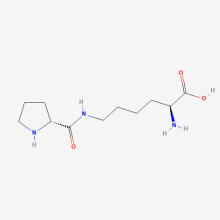
Nε -D-Prolyl-L-lysine
ncAA Structure (png, jpg, jpeg)
ncAA Utility
n/a
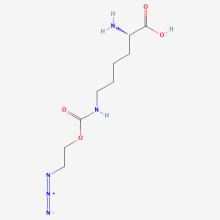
N6-((2-azidoethoxy)carbonyl)-L-lysine(AzeoK)
ncAA Structure (png, jpg, jpeg)
ncAA Utility
Reactive handle for azide-alkyne cycloaddition
N6-[(2 Propynyloxy)carbonyl]-L-lysine
ncAA Structure (png, jpg, jpeg)
![N6-[(2 Propynyloxy)carbonyl]-L-lysine](/sites/gce4all/files/styles/medium/public/2025-01/ketcher.png?itok=ZvMzQqGp)
ncAA Utility
Reactive handle for azide-alkyne cycloaddition
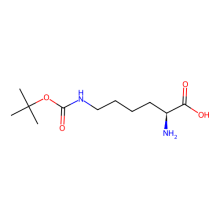
Nε-(tert-Butoxycarbonyl)-L-lysine (BocLys)
ncAA Structure (png, jpg, jpeg)
ncAA Utility
Extra-‐chromosomal array (low stability), biolistic bombardment. Scattered in different places in animal.
Norbornene-O–L-Lysine (NBO)
ncAA Structure (png, jpg, jpeg)
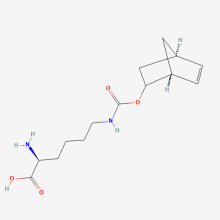
ncAA Utility
Reactive handle for IEDDA
N6-[(2-(3-Methyl-3H-diazirin-3-yl)ethoxy)carbonyl]-L-lysine (AbK; DiAzKs)
ncAA Structure (png, jpg, jpeg)
![N6-[(2-(3-Methyl-3H-diazirin-3-yl)ethoxy)carbonyl]-L-lysine](/sites/gce4all/files/styles/medium/public/2025-01/Page_20_Structure_6.png?itok=YosSmxRs)
ncAA Utility
Introduced as a photocrosslinking agent that was aliphatic rather than aromatic giving it more flexibility. Similar in structure to DiZPK.
RS Organism of Origin
Parent RS
RS Mutations
none
tRNA Organism of Origin
Parent tRNA
tRNA Anticodon
CUA
Multiple tRNAs?
Fifth foundational paper showed that for use in yeast it needed to be paired with the Mm tRNA, because the Mb tRNA was not orthogonal but was charged with Ala.
RS/tRNA Availability
N/A
Used in what cell line?
RS/tRNA Additional Notes
Foundational paper 1 shows incorporation of D-prolyl-Lys and cyclopentyloxycarbonly-Lys (Cyc).
Second foundational paper shows ability to efficiently install AzeoK (into myoglobin(4) at 3 mg/L) and 2-propynyloxy-K (at 2 mg/L), confirmed by MS, as well as BocLys.
Third foundational paper shows that in E. coli norbornene ncAA incorporated into GFP(150) at ~4 mg/L adn also myoglobin and T4 lysozyme all confirmed by MS. In mammalian cells incorporated both norbornene and azide ncAAs into the EGF receptor and showed norbornene reacted with tetrazine reagent but the azide reacted minimally with a cyclooctyne.
Fourth foundational paper shows can install AbK in E coli (with 1 mM AbK yielding myoglobin(4) at ~2 mg/L culture) and HEK293 cells. Fifth foundational paper shows it can also be used in yeast to install AbK.
Second foundational paper shows ability to efficiently install AzeoK (into myoglobin(4) at 3 mg/L) and 2-propynyloxy-K (at 2 mg/L), confirmed by MS, as well as BocLys.
Third foundational paper shows that in E. coli norbornene ncAA incorporated into GFP(150) at ~4 mg/L adn also myoglobin and T4 lysozyme all confirmed by MS. In mammalian cells incorporated both norbornene and azide ncAAs into the EGF receptor and showed norbornene reacted with tetrazine reagent but the azide reacted minimally with a cyclooctyne.
Fourth foundational paper shows can install AbK in E coli (with 1 mM AbK yielding myoglobin(4) at ~2 mg/L culture) and HEK293 cells. Fifth foundational paper shows it can also be used in yeast to install AbK.