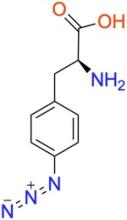
ncAA Structure (png, jpg, jpeg)
ncAA Foundational Publication Support
Chin, Jason W., Stephen W. Santoro, Andrew B. Martin, David S. King, Lei Wang, and Peter G. Schultz. 2002. “Addition of P-Azido-L-Phenylalanine to the Genetic Code of Escherichia Coli”. Journal of the American Chemical Society 124: 9026-27. doi:10.1021/ja027007w.
Miyake-Stoner, Shigeki J, Andrew M Miller, Jared T Hammill, Jennifer C Peeler, Kenneth R Hess, Ryan A Mehl, and Scott H Brewer. (2009) 2009. “Probing Protein Folding Using Site-Specifically Encoded Unnatural Amino Acids As FRET Donors With Tryptophan”. Biochemistry 48 (25): 5953-62. doi:10.1021/bi900426d.
Young, Douglas D, Travis S Young, Michael Jahnz, Insha Ahmad, Glen Spraggon, and Peter G Schultz. (2011) 2011. “An Evolved Aminoacyl-TRNA Synthetase With Atypical Polysubstrate Specificity”. Biochemistry 50 (11): 1894-900. doi:10.1021/bi101929e.
Seidel, Lisa, Barbara Zarzycka, Saheem Zaidi, Vsevolod Katritch, and Irene Coin. (2017) 2017. “Structural Insight into the Activation of a Class B G-Protein-Coupled Receptor by Peptide Hormones in Live Human Cells”. ELife 6. doi:10.7554/eLife.27711.
Amiram, Miriam, Adrian D. Haimovich, Chenguang Fan, Yane-Shih Wang, Hans-Rudolf Aerni, Ioanna Ntai, Daniel W. Moonan, et al. 2015. “Evolution of Translation Machinery in Recoded Bacteria Enables Multi-Site Incorporation of Nonstandard Amino Acids”. Nature Biotechnology 33: 1272-79. doi:10.1038/nbt.3372.
Kwok, Hui Si, Oscar Vargas-Rodriguez, Sergey Melnikov V, and Dieter Söll. (2019) 2019. “Engineered Aminoacyl-TRNA Synthetases With Improved Selectivity Toward Noncanonical Amino Acids”. ACS Chemical Biology 14 (4): 603-12. doi:10.1021/acschembio.9b00088.
ncAA Protocols
Cooley, Richard B, and Holger Sondermann. (2017) 2017. “Probing Protein-Protein Interactions With Genetically Encoded Photoactivatable Cross-Linkers”. Methods in Molecular Biology (Clifton, N.J.) 1657: 331-45. doi:10.1007/978-1-4939-7240-1_26.
Lightle, Hailey E, Parmila Kafley, Todd R Lewis, and Rongsheng E Wang. (2023) 2023. “Site-Specific Protein Conjugates Incorporating Para-Azido-L-Phenylalanine for Cellular and in Vivo Imaging”. Methods (San Diego, Calif.) 219: 95-101. doi:10.1016/j.ymeth.2023.10.001.
Seidel, Lisa, and Irene Coin. (2018) 2018. “Mapping of Protein Interfaces in Live Cells Using Genetically Encoded Crosslinkers”. Methods in Molecular Biology (Clifton, N.J.) 1728: 221-35. doi:10.1007/978-1-4939-7574-7_14.
Serfling, R, and I Coin. (2016) 2016. “Incorporation of Unnatural Amino Acids into Proteins Expressed in Mammalian Cells”. Methods in Enzymology 580: 89-107. doi:10.1016/bs.mie.2016.05.003.
ncAA Utility
Used as a photocrosslinker, allowing for crosslinking and also for bioorthogonal click-chemistry ligation of proteins via strain-promoted cycloadditions (SPAAC) with suitably functionalized molecules.
For crosslinking, short wave UV light (~280 nm) is typically used. Upon absorbing a photon, the activated intermediate can crosslink to neighboring atoms, if present. If no crosslinking is possible, it will relax to a ground state that cannot be reactivated.
For crosslinking, short wave UV light (~280 nm) is typically used. Upon absorbing a photon, the activated intermediate can crosslink to neighboring atoms, if present. If no crosslinking is possible, it will relax to a ground state that cannot be reactivated.
ncAA Source
Exogenous - Purchased
ncAA Availability
Can be purchased from Sigma (https://www.sigmaaldrich.com/US/en/product/sial/909564), or Bachem (https://shop.bachem.com/product/4096192/)
RS/tRNA Pair Usage Information
For incorporation in E. coli, it seems that three Mj RSs available from Addgene are commonly used: the originally evolved "pAzPhe-RS1 (enhanced)", and p(sp)Phe-RS and the polyspecific RS, which are nearly identical. The latter two have both been called pCNF-RS and they differ only in an I159P vs I159A mutation. The "pAzPhe-RS1 (2019)" was derived from the polyspecific RS as part of testing a directed evolution strategy but does not supercede the others for general use.
Mj RSs pAzFRS.1.t1, pAzFRS2.t1, pAcFRS1.t1 (also available from Addgene) were specifically evolved from the polyspecific RS for use in the C321.ΔA E. coli strain to improve the insertion of multiple (as many as 30) pAzFs into a single protein. All have lowered fidelity, with pAzFRS.1.t1 having the best fidelity and highest specificity for pAzF.
For incorporation of pAzF in mammalian cells, the E coli Tyr RS derived EAziRS is available from Addgene and seems to be the go-to system.
Mj RSs pAzFRS.1.t1, pAzFRS2.t1, pAcFRS1.t1 (also available from Addgene) were specifically evolved from the polyspecific RS for use in the C321.ΔA E. coli strain to improve the insertion of multiple (as many as 30) pAzFs into a single protein. All have lowered fidelity, with pAzFRS.1.t1 having the best fidelity and highest specificity for pAzF.
For incorporation of pAzF in mammalian cells, the E coli Tyr RS derived EAziRS is available from Addgene and seems to be the go-to system.
RS/tRNA Pair(s)
ncAA Synonyms
4-Azido-L-phenylalanine
H-P-AZIDO-PHE-OH
4-Azidophenylalanine
(S)-2-Amino-3-(4-azidophenyl)propanoic acid
p-azidophenylalanine
p-azido-l-phenylalanine
(2S)-2-amino-3-(4-azidophenyl)propanoic acid
L-Phenylalanine, 4-azido-
AZF
pAzF
p-azido-L-Phe
H-P-AZIDO-PHE-OH
4-Azidophenylalanine
(S)-2-Amino-3-(4-azidophenyl)propanoic acid
p-azidophenylalanine
p-azido-l-phenylalanine
(2S)-2-amino-3-(4-azidophenyl)propanoic acid
L-Phenylalanine, 4-azido-
AZF
pAzF
p-azido-L-Phe
ChEBI ID
228211
ncAA Additional Notes
Review discussing different mechanisms of photocrosslinking functional groups: https://doi.org/10.1002/anie.202520744